A field trip to the British museum was arranged by one of my lectures to help with our study on critical game design. we was shown around and saw some really interesting ancient artifacts.
we saw some of the ancient board games we have been looking and playing in our lectures and seeing the actually board of them which was made years and years ago really was interesting to me.
I didn't take any pictures my self but here are some of the things which we saw when visiting the museum.
British Museum. (). Royal Game of Ur. [Available online]: http://en.wikipedia.org/wiki/Royal_Game_of_Ur.
[Accessed 6th March 2015]
British Museum. (). ancient chess. [Available online]: http://www.tripadvisor.com/LocationPhotoDirectLink-g186338-d187555-i89949351-British_Museum-London_England.html.
[Accessed 6th March 2015]
Friday, 6 March 2015
Tweaking Ancient Games
The ancient game I will be tweaking is called: Hnefetafl
First iteration: I made it where the attacking team are allowed to move two of their pieces in a single
turn. To balance this out I also made sure that the attacking team couldn't capture the defending team’s pieces apart from the king. When these new rules were
tested I found that the game lasted longer than the usual five to ten minutes.
If after playing the game for a few minutes the defending team fails to get a
piece behind the attacking team to allow a capture to happen, the game slowly comes
to a halt, and both sides are unable to move around the board.
Second iteration: I change the rules slightly. I decided that the king could get captured the
same way as other pieces could, one on each side and not one on all four sides.
The second rule that I added was that the king could assist other pieces on capturing
the attacking team pieces. By doing this the attacking team would have to be
quicker when it came to capturing the king as it will become easier for the
king to escape from difficult situations. When it came to play-testing these
new rules the games became quicker. They lasted around four to six minutes
each. Both the attacking and defending sides had an even chance of winning with
these rules where the attacking team was winning more than usual compared to the
original rules.
Third iteration: I decided to
add a facture where the attacking team had to capture the opponent’s king
within 15 turns. If this attempt was failed it would result in victory for the defending
team. To make this achievable, the defending team was not allowed to capture
the opponent’s pieces or move one of their own pieces back to where it
originally was. To make capturing easier, the attacking team can capture the
king in the same way that other pieces could be captured on the board. When
these rules were play-tested I found that the games lasted around five to eight
minutes, even longer when the player takes time to think about his next move.
Out of five games the attacking team only claimed victory one time, where the
defending player started to move one spare at a time not making a gap for the
attacking team.
Fourth and final iteration I
decided to change how the defending team was able to win the game. The original
rules say that the king must reach one of the four sides of the board to achieve
victory but I decided to change it to being one of the four corners of the
board. I felt as though this would be bit more of a challenge for the defending
team. To balance this rule out, the attacking team was not able to place one of
their pieces on one of the four corners, as this would stop the opponent’s team
completely from reaching one of the corners. When play-testing with these rules
I found that the games lasted a lot longer than usual and were lasting around
seven to ten minutes. This is because the defending team had difficulty in reaching
one of the corners with their pieces. Three games were played with these rules
and all three games ended with the same result. These rules favoured the attacking
team more as I was finding that the attacking team was blocking the defending
team and therefore stopping their king from reaching one of the corners.
Ancient games: Hnefetafl
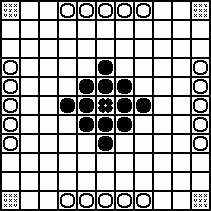
Hnefetafl is a board game which has two sides. The attackers team is arranged in groups of 6 at each side of the board, making a total of 24 pieces and the defenders team is arranged around the king which is placed in the center of the board. The aim of the attackers team is to capture the king.
The aim of the defenders team is to get their king to one of the four corner of the board. The Game starts with the attacking team making the first move.
Each pieces on the board all move the same way. A piece can move; forwards, backwards, left and right but can not move diagonally. every piece can move one or more squares, until it is stopped by the another piece, The central square is the starting square for the king, no other piece can move on this square but they can move over it.
To take one of the other players pieces you have to capture them, by doing this you have to place one of your own pieces either side of the other players piece. any side in the game can take more then one piece in a turn if your own pieces are positioned in the right places to do so, no more then three pieces can be taken in a turn. once the king has moved away from the center square then that square can be used for either side to act like a piece of their own and capture the other teams pieces. if at anytime the king is captured by the attacking team then it is game over and the attacking team wins the game.
Hnefatafl. (). Hnefatafl. [Available online]:
http://www.fetlar.org/assets/files/hnefatafl-rules-02-09-2012.pdf.
[Accessed 6th March 2015]
Hnefatafl
board. (). Hnefatafl board. [Available online]: http://www.jamesadamshistoricenterprises.com/treasuretrove/images/hnefatafl_boards3.gif.
[Accessed
26th February 2015]
Sunday, 2 November 2014
Defining games: Caillois' terminology
A Paidia game is where the user/player plays for fun and where random things happen which where made by the user/player for doing actions corrected by them self such as things being destroyed, glitching and exploring. My first example of this is 'Dead rising 3' made by Capcom Vancouver. Published by Microsoft studios (2013). This game allows the players to do what they please in a zombie outbreak giving the players choices to do random events or continue doing what they please. By these features it puts this game in the alea categories.
My seconded example is 'sunset overdrive' made by Insomnica games. Published by Microsoft studios (2014). This game is slimier to my first example where it allows the player to choice what they choice to do without any consequence, Sunset Overdrive takes place in sunset city in the year 2024 witch is now being controlled by a virus that started over a energy drink. By these features it puts this game in the alea and ilinx categories.
A Ludus game is where the user/player plays by a set of rules and the game only goes one way which the designer choose for it. My first example is 'Call Of Duty: Black Ops 2' made by Treyarch. Published by Activision (2012). This first person shooter game has a set story line which players have no choice but to go by, the only choices players get to make is the way they approach missions only giving them one outcome. By these features it put this game in the mimicry and agon categories.
My second example is 'Halo 4' made by 343 Industries. Published by Microsoft studios (2012). This game is also a first person shooter which has a set story for players to follow not giving them choices to change the outcome, The game does have little side things to do A.K.A Easter eggs but doesn't change anything to the game its self making it a Ludus game. By these features it put this game in the mimicry and agon categories.
My seconded example is 'sunset overdrive' made by Insomnica games. Published by Microsoft studios (2014). This game is slimier to my first example where it allows the player to choice what they choice to do without any consequence, Sunset Overdrive takes place in sunset city in the year 2024 witch is now being controlled by a virus that started over a energy drink. By these features it puts this game in the alea and ilinx categories.
A Ludus game is where the user/player plays by a set of rules and the game only goes one way which the designer choose for it. My first example is 'Call Of Duty: Black Ops 2' made by Treyarch. Published by Activision (2012). This first person shooter game has a set story line which players have no choice but to go by, the only choices players get to make is the way they approach missions only giving them one outcome. By these features it put this game in the mimicry and agon categories.
My second example is 'Halo 4' made by 343 Industries. Published by Microsoft studios (2012). This game is also a first person shooter which has a set story for players to follow not giving them choices to change the outcome, The game does have little side things to do A.K.A Easter eggs but doesn't change anything to the game its self making it a Ludus game. By these features it put this game in the mimicry and agon categories.
Games Britannia: "Dicing with Destiny"
Watching this hour long documentary by Benjamin Woolley as he spoke about games which go back to the Victorian era I found that there wasn't much differences between game then and now. Each one had it's own form of competitiveness from fun to winning, by this I mean each game had it's unique way of making the players want to win either if it's a friendly game such as 'Chest' which makes you think hard about your next choice even making you choose to sacrifice a certain piece to gain more control over the game.
I find games which know how to control the behavior of the player can have an effort on people to make them want to play the game them self which make videogame's today popular on 'YouTube'. Either tho games today are digital they still have the same effect as bored games or any other type of games which can draw the player in to want more.
Woolley spoke about the game 'Snakes and ladders' which is a well known kids game and how it changed the world on how games are played. Snakes and ladders have nothing to do with each other but some how works when put into a game which made it into many family homes and can be played by any age which games today can lake on.
I watched the episode here: http://www.bbc.co.uk/programmes/b00p90d8
Changing Battleships rules
The rules for 'Battleship' work very well and can provide hours of fun but what can happen when you change some game mechanics such as adding new rules which can change the style of the game.
Playing Battleship with new rules gave a different feel to which most people have played are used to. The new rules which we added to the game where every 3 turns the player has they get to use a different attack which allows them to hit 3 spaces on their opponents side unless their 5 space ship is destroyed. An other rule which was added gave the player the ability to move their 2 space ship by 1 space every 5 turns it wasn't hit (this rule didn't apply once it got hit once).
I found that these new rules went well with the game and didn't change to much keeping the main mechanics of the game working well which was the main goal of the task.
Playing Battleship with new rules gave a different feel to which most people have played are used to. The new rules which we added to the game where every 3 turns the player has they get to use a different attack which allows them to hit 3 spaces on their opponents side unless their 5 space ship is destroyed. An other rule which was added gave the player the ability to move their 2 space ship by 1 space every 5 turns it wasn't hit (this rule didn't apply once it got hit once).
I found that these new rules went well with the game and didn't change to much keeping the main mechanics of the game working well which was the main goal of the task.
Blibliography
Nick, F. The strange case of the casual gamer. Page, 143-163. In Isbister, Katherine. Schafer, Noah. (2008). Game usability. Burlington, USA: Morgan kaufmann
Geoff, K. Die hard/try harder: narrative, spectacle and beyond, from hollywood to videogame. Page, 50-64. in King, Geoff. Krzywinska, Tanya. (2002). Screenplay:cinema/videogames/interfaces. London, U.K.:Wallflower Press
Subscribe to:
Posts (Atom)